


As spacecraft become more autonomous, they will increasingly need to maneuver near other spacecraft and structures while respecting hard physical and operational constraints. In our latest work, we explore how convex optimization can be used to synthesize nonlinear feedback controllers for relative orbital motion that incorporate those constraints directly into the controller design, while retaining formal stability guarantees. Read the full paper here!
Want to work with us on this project or any others? Explore our Opportunities to join the OS Team, or join our Advancement Network to collaborate with us.
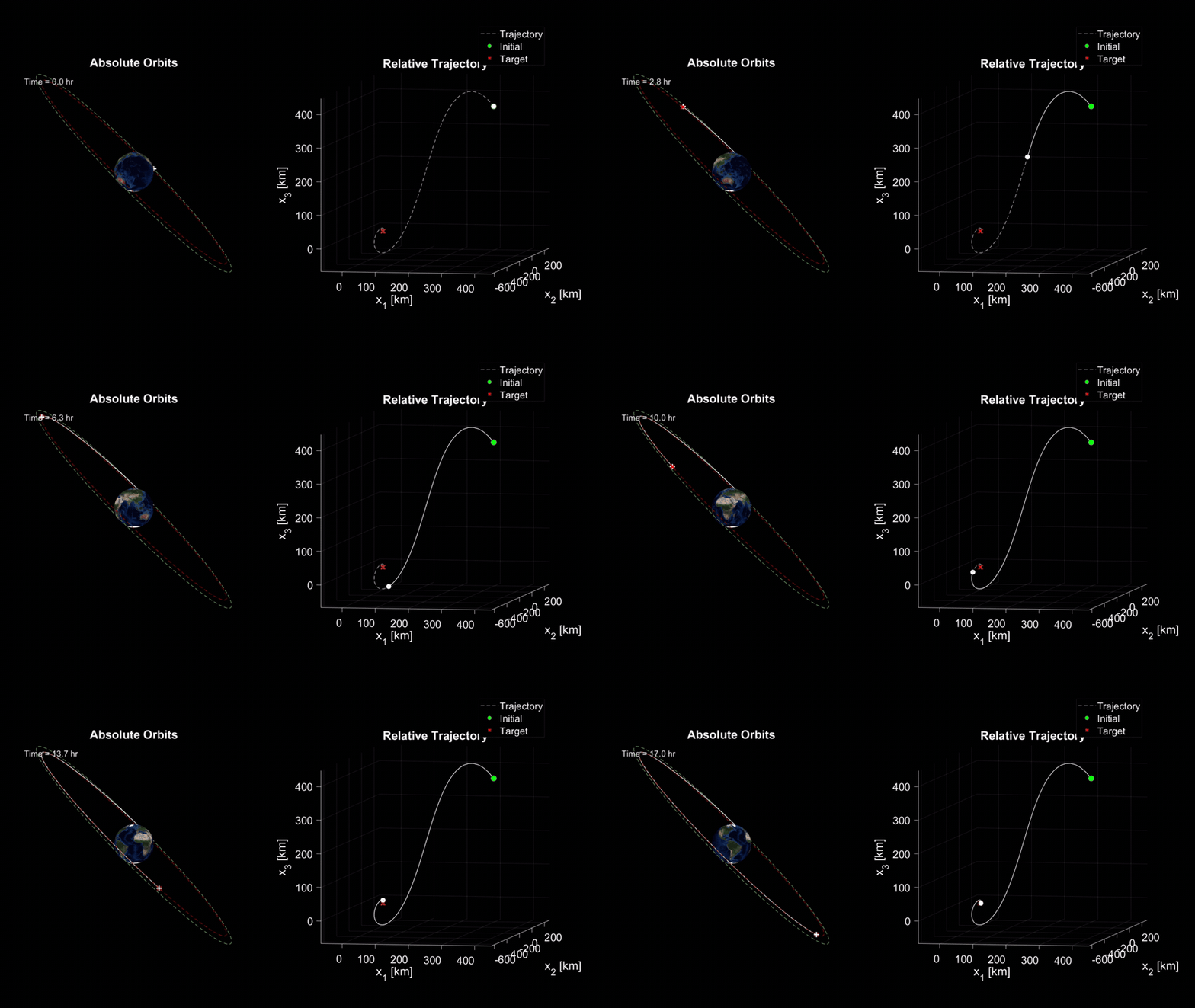
Proximity Operations Need Better Controllers
Many of the things we want to do in space, from servicing satellites to assembling large structures, require spacecraft to maneuver safely around one another. But relative orbital motion is nonlinear, and real vehicles must also contend with constraints like limited thrust, sensor fields of view, and safe approach regions. Our goal is to design controllers that account for those realities directly, while still providing formal guarantees about their behavior.
Existing methods tend to make a tradeoff. Linear controllers like LQR are fast and simple, but rely on simplified dynamics and offer mainly local guarantees. More sophisticated methods like Model Predictive Control can handle nonlinearities and constraints, but require solving an optimization problem onboard as the spacecraft flies.
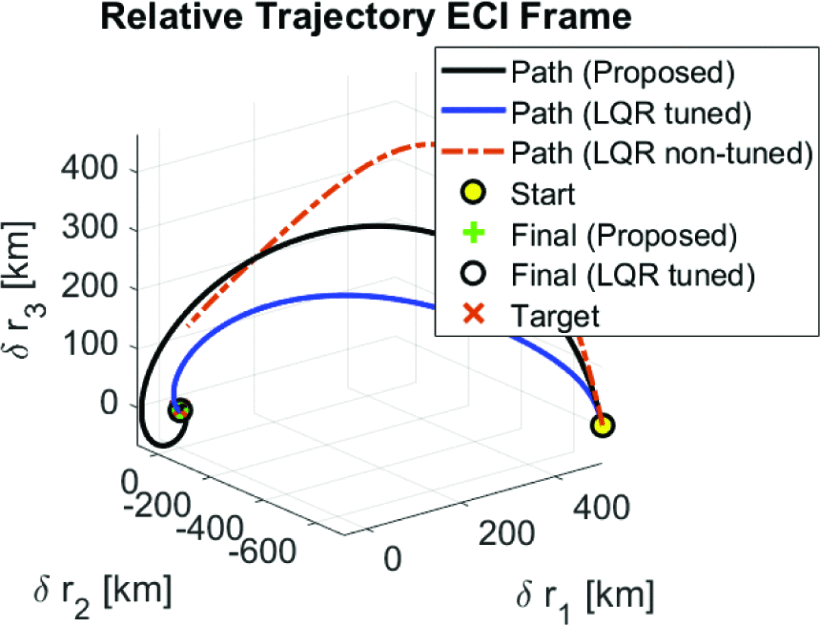
Our approach asks a different question: can we solve the hard optimization ahead of time, and use it to design the controller itself?
Optimize the Controller, Not the Trajectory
Instead of optimizing a single maneuver, we use convex optimization to design the feedback law itself. The result is a nonlinear controller that can be synthesized offline, then evaluated onboard as a simple function of the spacecraft’s current state, without solving a new optimization problem at every timestep.
The first challenge is mathematical: the full nonlinear orbital dynamics contain terms that are not polynomial, which prevents us from applying polynomial optimization directly. We introduce a small number of auxiliary variables that “lift” the dynamics into a higher-dimensional space where they become polynomial, while remaining tied to the original system through algebraic constraints.
Designing a nonlinear controller is only part of the problem, we also want a way to certify that it actually drives the spacecraft toward its target. We use a dual Lyapunov formulation based on a density function that describes how trajectories flow through state space. This reformulation makes it possible to search for the controller and its stability certificate together using convex optimization.
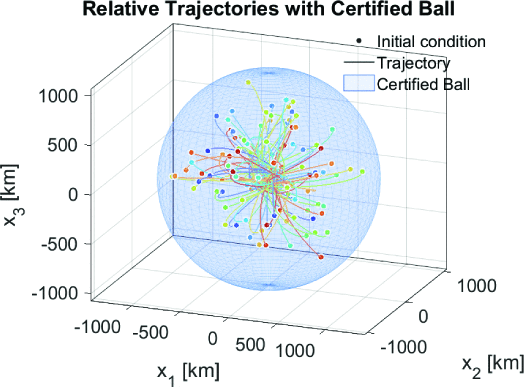
The remaining question is how to enforce that stability condition computationally. We use sum-of-squares optimization, which lets us replace a difficult polynomial positivity problem with a semidefinite program, a class of convex optimization problems that can be solved reliably. This gives us a practical way to synthesize both the nonlinear controller and its certificate in one optimization.
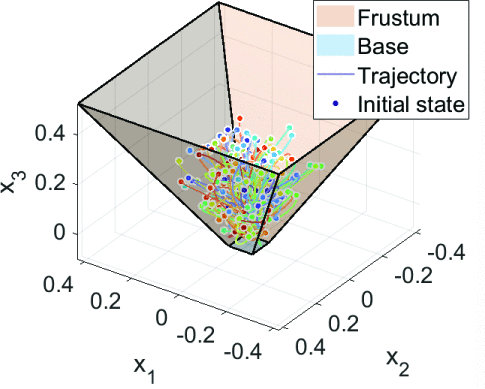
Once the problem is in this form, practical constraints can be added directly to the controller synthesis. In the paper, we demonstrate this with both thruster saturation limits and a sensor field-of-view constraint, shaping the controller so that it drives the spacecraft toward its target while respecting the operating region we specify.
What This Enables
In simulation, the resulting controller compared favorably with a tuned LQR baseline. For a large rendezvous maneuver, it achieved a lower final error with smoother, lower-peak thrust, and under noisy and biased state estimates it reached a final error of 1.74 km compared with 6.55 km for LQR while also using less control effort.
For the Orbital Yard, this is an early step toward the kind of low-level autonomy needed for robotic construction in orbit. Assembly agents will need to repeatedly approach, align with, dock to, and move around other spacecraft and structures while respecting constraints such as thrust limits, sensor visibility, approach corridors, and eventually collision and plume-impingement boundaries. A controller that can encode these considerations ahead of time, while remaining cheap to evaluate onboard, could form part of the control layer beneath higher-level planning and coordination.
There is still significant work to do. Sum-of-squares methods become expensive as systems grow in dimension and complexity, and the current work focuses on relative motion about a circular chief orbit. Extending these ideas to richer orbital dynamics, stronger safety guarantees, and eventually multi-agent systems is the next challenge. More broadly, the goal is to move toward spacecraft autonomy where expensive reasoning can be done offline and compiled into fast, constraint-aware controllers that are ready to operate in the physical world.
Enjoyed this post? Stay connected with Manifold by following us on Twitter and LinkedIn, and joining our community on Discord. You can also follow our Luma calendar for upcoming talks and events, and subscribe to the Research Log at the bottom right of this page for more project releases like this one.